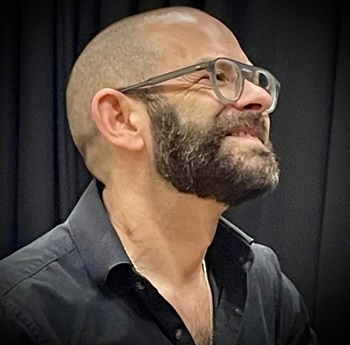
Prof Anthony Bale, Faculty of English
apb90@cam.ac.uk
Biographical Information
Professor Anthony Bale, FEA, FBA
Professor of Medieval & Renaissance English (1954); Professorial Fellow, Girton College.
BA (Oxford), MA (York), DPhil. (Oxford). Fellow of the English Association; Fellow of the British Academy.
I attended Madeley High School, a comprehensive school on the Staffordshire/Cheshire border, and then a state sixth-form college in Stoke on Trent.
Research Interests
I research later medieval English literature and culture.
My early work focussed on Christian-Jewish relations, popular religion, and the history of antisemitism, followed by studies of the poetry of John Lydgate, the cult of St Edmund of East Anglia, and medieval histories of emotion. This then led me into pilgrimage studies, the history of Jerusalem and the Holy Land, and editing and translating The Book of Marvels and Travels (Oxford UP, 2012) by John Mandeville and The Book of Margery Kempe (Oxford UP, 2016). Throughout my work I've been concerned with the relationship between margins and peripheries in medieval culture, and with recovering neglected sources and voices from the medieval past.
My research has been supported by grants from the British Academy, the Leverhulme Trust, the Arts and Humanities Research Council, among others. I have spent several periods as a visiting scholar at the Huntington Library in California and have been awarded visiting fellowships at the University of Michigan at Ann Arbor (Frankel Fellowship), the University of Melbourne (Distinguished International Fellowship in the History of Emotions), Harvard University (Bloomfield Fellowship), the University of Wisconsin at Madison (Brittingham Fellowship), and the National Humanities Center, North Carolina.
I have been involved in several projects curating exhibitions, as academic advisor for the Jewish Museum London’s Blood: Uniting and Dividing (2015-16) and Jews, Money, Myth (2019), which won the Museums Association Museums Change Lives award (2019). I also curated Capsule: Inside the Medieval Book with Leverhulme Artist-in-Residence collaborator, artist Shay Hamias, and was a member of the academic advisory team for the British Library's acclaimed Medieval Women: In their Own Words exhibition (2024-5). From 2020-2022 I was President of the New Chaucer Society, the leading scholarly society for the study of the literature and culture of the age of Chaucer. I am currently developing the Medieval Ideas Creative Lab at Cambridge, which encourages creative interractions with medieval sources.
In 2023 I published A Travel Guide to the Middle Ages: the World through Medieval Eyes (Penguin, 2023; Norton 2024), a work of creative non-fiction which used medieval travel writing to explore premodern ideas of travel and imaginative geography. This book has since been translated into Bulgarian, Chinese, Czech, Dutch, German, Hebrew, Italian, Japanese, Korean, Polish, Portuguese, Romanian, Russian, Serbian, Spanish, and Turkish (with further translations to follow).
From 2023-26 I held a Leverhulme Major Research Fellowship to support my research on the Ottoman Siege of Rhodes (1480) and the development of late medieval news media. The project website is here. As part of this project I have been working on a new critical edition of John Kay's Siege of Rhodes (1481/2), as well as thinking about information flows in medieval Europe, Hospitaller publishing networks, the cultural figure of the renegade, and the value of novelty in medieval culture.
I have recently completed a new creative non-fiction book, The First Witches, on the earliest witchcraft allegations in medieval England and Europe, focussing on the Kilkenny witchhunt in 1324. This book brings together my long-standing interests in popular culture, symbolic and real violence, the work of the imagination, and the margins of medieval culture.
Areas of Graduate Supervision
I am interested in graduate supervision across late medieval literature and culture. My research interests cover many aspects of medieval English language and literature, as well as translation and adaptation, creative non-fiction, travel writing, religious writing, the cultural history of Jerusalem and the Holy Land, popular religion, and manuscript studies.
Selected Publications
- Some recent publications:
-
‘Introduction’, Geoffrey Chaucer. Volume III: La Légende des bonnes dames et autres textes, ed. Jonathan Fruoco (Paris: Classiques Garnier, 2026), pp. 225-36.
-
‘The Middle Ages as creative “topic”’, Public Humanities (in press, 2026).
-
‘Mandeville’s Natural History’, in The Oxford Handbook to Middle English Prose, eds. Emily Steiner and Sebastian Sobecki (Oxford: Oxford University Press, 2026/7), in press
-
Anthony Bale, 'Three funerals', in eds. Justin Bengry, Matt Cook, Rebecca Jennings, E. J. Scott, A Queer Scrapbook: Britain and Ireland since 1945 (Manchester: Manchester University Press, 2026)
-
Anthony Bale, 'Jerusalem', in ed. Sebastian Sobecki, The Cambridge Guide to Global Medieval Travel Writing (Cambridge: Cambridge University Press, 2025), pp. 537-55.
-
Anthony Bale, 'Thinking with the renegade', Journal of Medieval and Early Modern Studies 55 (2025), 439-465.
-
Anthony Bale, A Travel Guide the Middle Ages: the World through Medieval Eyes (London: Viking Penguin, 2023; New York: Norton, 2024). Also in Bulgarian, Chinese, Czech, Dutch, German, Italian, Polish, Portuguese, Romanian, Russian, Spanish, translations.
-
Anthony Bale, 'News from the East', Studies In The Age of Chaucer 45 (2023), pp. 3-33.
-
Anthony Bale, Margery Kempe: A Mixed Life, Medieval Lives series (London: Reaktion Books, 2021).
- Anthony Bale and Daniela Giosuè, 'A women's network in fifteenth-century Rome: Margery Kempe encounters "Margaret Florentyne"', in eds. Laura Varnam and Laura Kalas, Encountering the Book of Margery Kempe (Manchester: Manchester University Press, 2021)Anthony Bale and Kathryne Beebe, co-editors of special volume on 'Pilgrimage and textual culture', Journal of Medieval and Early Modern Studies 51 (2021), with introductory essay, pp. 1-8.
- Anthony Bale, 'Reflections on Chaucer, Pedagogy, and the Profession of Medieval Studies', New Chaucer Studies: Pedagogy and Profession 1 (2020), pp. 5-17.